

The Bengaluru real estate outlook 2027 is shaped by three things: prices that are still rising, sales that are growing slowly, and a supply pipeline that is bigger than ever. If you are planning to buy, sell or invest in the next 12 months, here is what the latest data actually says, without the hype.
Where Bengaluru Property Prices Stand Today
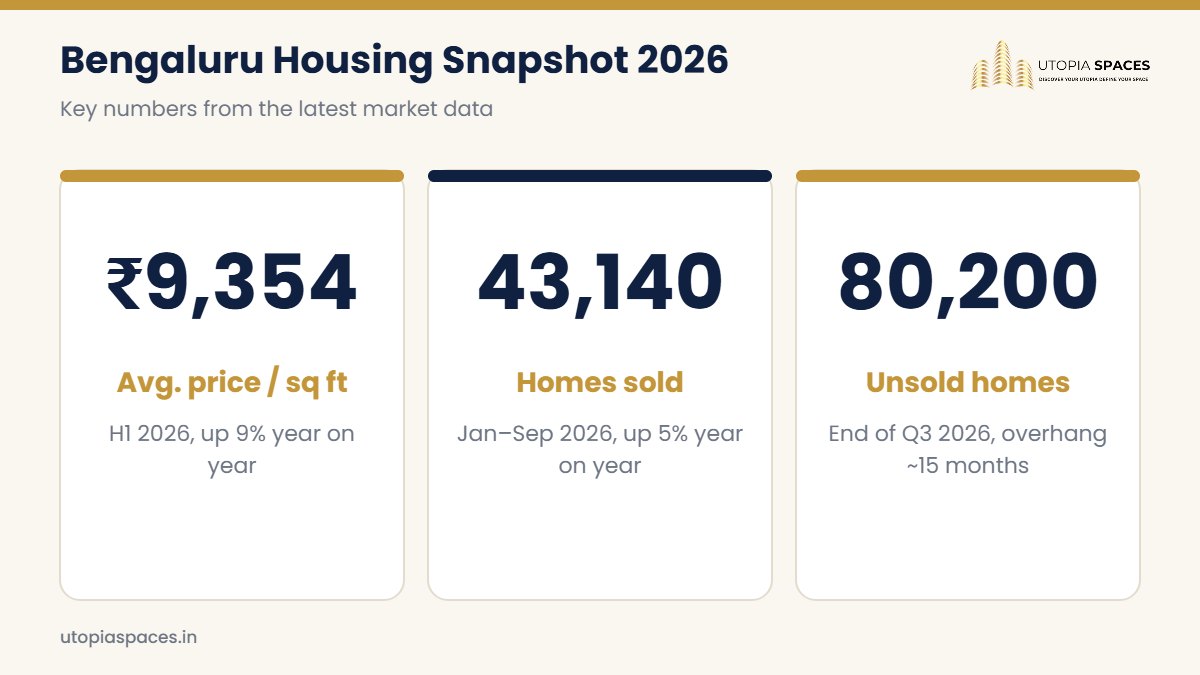
According to the latest market reports for H1 2026 (January–June), the average residential price in Bengaluru reached about ₹9,354 per sq ft, a 9% rise year on year.
Q3 2026 data points the same way. The average quoted base price for the city was around ₹9,600 per sq ft, and for January–September 2026 prices were up about 11% year on year. Different research firms measure prices differently, but the data agrees that prices kept climbing through 2026.
Sales are growing, but more slowly
- H1 2026: 27,968 homes sold in Bengaluru, up 5%.
- January–September 2026: 43,140 homes sold, up 5%.
- Q3 2026 alone: about 16,650 homes sold, up 12% year on year.
Demand is steady, not booming. Nationally, homes priced above ₹1 crore made up 54% of sales in H1 2026, up from 49% a year earlier. Buyers are moving towards bigger, better-located homes.
The Supply Side: More Choice for Buyers
The biggest change in 2026 has been supply. There were about 80,200 unsold units in Bengaluru at the end of Q3 2026, up 35% from a year earlier. Launches in Q3 were about 17,700 units, up 16% year on year.
North Bengaluru led this wave. North accounted for 46% of all Q3 launches, and launches there more than doubled (+121% YoY). East Bengaluru still has the largest share of sales (44%) and the largest share of unsold stock (48%).
The positive side is that the inventory overhang, meaning how long it would take to sell current stock at today’s pace, stayed stable at 15 months. That is healthy, not a glut.
What the Forecasts Say for 2027
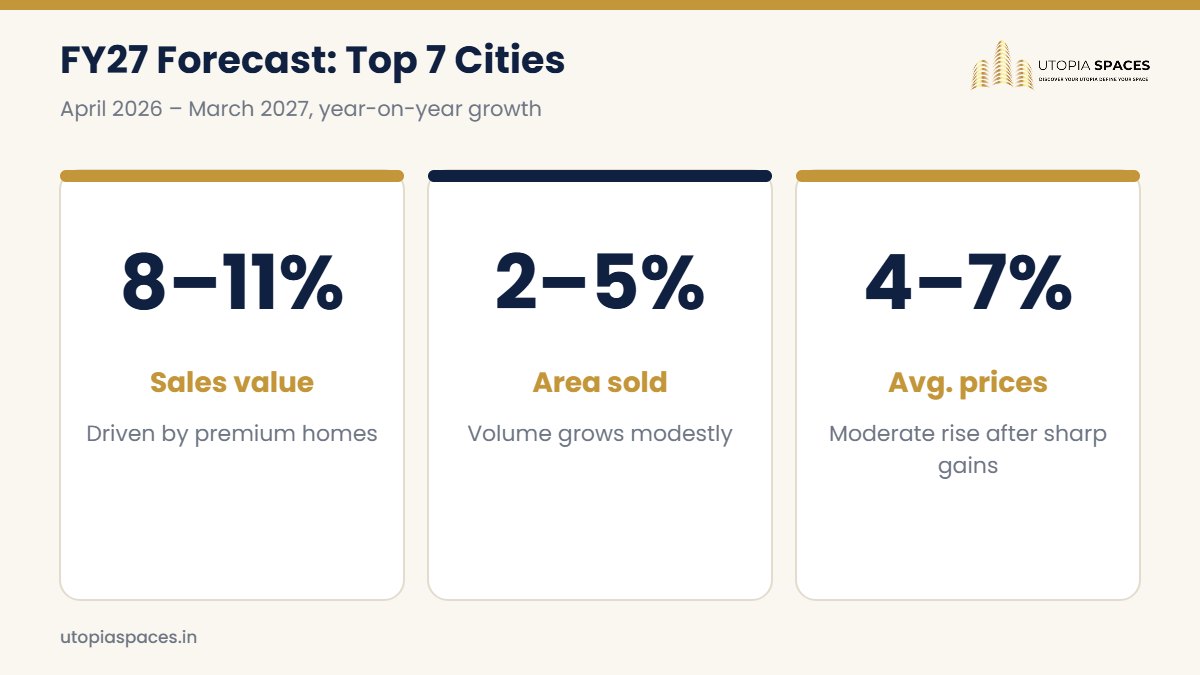
Industry forecasts expect, for the top seven cities in FY27 (April 2026–March 2027):
- Home sales value to grow 8–11%, driven by premium homes.
- Area sold to grow a more modest 2–5%.
- Average selling prices to rise a moderate 4–7%, after sharp gains in recent years.
These forecasts are for all seven cities, not Bengaluru alone. But they give a useful direction: price growth is likely to slow from double digits to single digits, while premium projects continue to take a bigger share of the market.
Interest rates are the new variable
On 7 October 2026, the RBI raised the repo rate by 25 basis points to 5.50% and moved its stance to “calibrated tightening”. Most home loans are linked to the repo rate, so EMIs on floating-rate loans can rise when it goes up.
Infrastructure is still a key driver
The elevated section of the Namma Metro Pink Line (Kalena Agrahara to SG Palya, formerly Tavarekere, 7.5 km, 6 stations) opened to the public on 14 November 2026. The underground section to Nagawara is still under construction. Better metro access makes daily commutes easier for residents along these routes.
Where Prices Are Likely Headed: Our Reading
Putting the data together, here is a sensible way to look at 2027:
- Steady, slower growth: With forecasts pointing to 4–7% price growth and unsold stock rising, a repeat of the double-digit jumps seen earlier is less likely.
- Location will matter more: H1 2026 data showed KR Puram (+20%), Yelahanka (+18%) and Whitefield (+14%) rising much faster than the city average. Infrastructure-linked areas will likely continue to outperform.
- Buyers get more negotiating room: High launch volumes, especially in North Bengaluru, mean more choice and better offers from developers.
- Loan costs need watching: The rate cycle has turned upward, so plan your budget with a buffer.
Want to know which localities stand out? Read our guide to the top 10 areas to invest in Bengaluru in 2027, or see whether 2027 is the right time to buy a home.
What This Means for You
End-users: Rising supply means you can compare and negotiate. Focus on builder track record, RERA status and possession timelines.
Investors: Look at corridors where new infrastructure is going live, and be realistic about returns, expecting single-digit annual appreciation rather than double-digit.
Browse verified projects across Bengaluru on our Explore page, or talk to the Utopia Spaces team for a free shortlist based on your budget.
Note: Figures are based on published market research reports. Different firms use different methods, so numbers may not match exactly. This article is for information only and is not financial advice.
Frequently Asked Questions
Will Bengaluru property prices rise in 2027?
Current data points to continued but slower growth. Bengaluru prices rose about 9% in H1 2026, and forecasts expect average prices in the top seven cities to rise 4–7% in FY27.
Is there oversupply in Bengaluru?
Unsold stock rose to about 80,200 units in Q3 2026, but the inventory overhang stayed stable at around 15 months, which is a healthy level.
Which areas are growing fastest?
H1 2026 data showed KR Puram (+20%), Yelahanka (+18%) and Whitefield (+14%) among the fastest-rising localities over 12 months.